
Cuyahoga County Busted Mugshots at Booking
Every busted mugshot in Cuyahoga County starts at one place: the Cuyahoga County Corrections Center, known as CCCC. The Sheriff's Corrections Division runs the facility, which covers both Jail I and Jail II. When someone is committed there, the jail creates an identification record for that person. The arresting police department keeps its own paperwork, too. So in Cleveland, Parma, or Lakewood, a city incident report and a county custody entry are two different records, not duplicates of one another.
Ohio's full-service jail rule drives the paperwork. Each commitment gets a booking and identification record. Reception includes a photograph or an ID bracelet. What the public sees is narrower than what the jail keeps. The full internal file holds operational details that never appear in a public display.
One more layer matters here. CCCC is the county's central booking path, but it is not the only record holder. Police hold the incident and arrest record. Corrections holds the custody record. The clerk's docket picks up the case once it reaches court. A person can show up in one layer and be absent from another, and that is not a contradiction. Match the official source to your question before making a request.
Keep that annual figure in perspective. It measures jail throughput, nothing else. It is not a daily headcount, not a count of unique people, not a count of convictions, and not a tally of public booking photos.
Cuyahoga County Booking Record Fields
A booking file ties a person to an agency, a commitment time, and the jail's first entry. Not every field is public. Some stay restricted or missing. At launch, the Sheriff app reportedly showed a limited set of identity, entry-time, charge, and photo data, and the county has never posted a browser field list promising more.
Timing gets tricky. A booking time is not always the arrest time. Transport, medical review, and classification can all happen in between. A court case number is separate from a jail identifier. Link records through the agency and the dates, then turn to the docket for the outcome.
Internal details like medical notes, property lists, and housing assignments can sit in a jail file without being ordinary public mugshot fields. Do not fill a missing field by guessing from an unofficial copy. A bond or release date describes a jail event. Nothing more.
| Field | What it shows |
|---|---|
| Name and aliases | Identity used during intake. Confirm similar names with the agency or court. |
| Booking identifier | The jail’s internal reference for the custody record, when available. |
| Commitment date and time | When jail custody began, which can differ from the arrest time. |
| Arresting agency | The department or authority that brought the person to custody. |
| Charges as booked | Initial charges at intake, not a court disposition. |
| Photograph | An intake identification image, reportedly displayed in the Sheriff app at launch. |
| Bond and court details | Release conditions or case path when public and entered by the responsible office. |
| Release information | A county-custody event, not a finding about the final case outcome. |
Cuyahoga Busted Records Requests
When the app falls short, go straight to the county's official public-records request route or the arresting city's records office. Filing is free. Copying fees may apply where the law allows. A narrow request beats a blanket one, so ask for the specific item rather than everything tied to a name.
Details make the request work. Name the person. Give an approximate arrest or booking date, plus the arresting agency and any booking or case number. Say exactly what you want. Ask whether Corrections, the police department, or another office holds it. For a city arrest, start with that city's police records unit, since the report may not line up with the CCCC custody entry.
Ohio's public-record process rarely delivers instant results. An office may need time to locate a record, review it, estimate costs, or explain an exemption. Want a photograph? Ask the custodian what format exists and whether any restriction applies. Keep the agency's response on file, especially when a record has been corrected, sealed, transferred, or cannot be found under the name you used.
- Open the county public-records request form or contact the agency that made the arrest.
- State the date range, agency, person’s identifying details, and whether the request is for a booking record, photograph, or another defined item.
- Request an electronic copy when practicable and ask for an estimate before substantial copying.
- Ask the custodian to say whether the record is unavailable, restricted, transferred, or subject to an approved retention schedule.
Sheriff records contact. Cuyahoga County Sheriff's Department, Records/Warrant Division, 1215 West 3rd Street, Cleveland, OH 44113. Call 216-443-6100. The county lists Corrections at 216-443-6125; confirm the right desk and its hours before you visit.
A view of the county request page appears below. It serves as the official fallback for a particular county-held record, not as a replacement for a current-custody check.
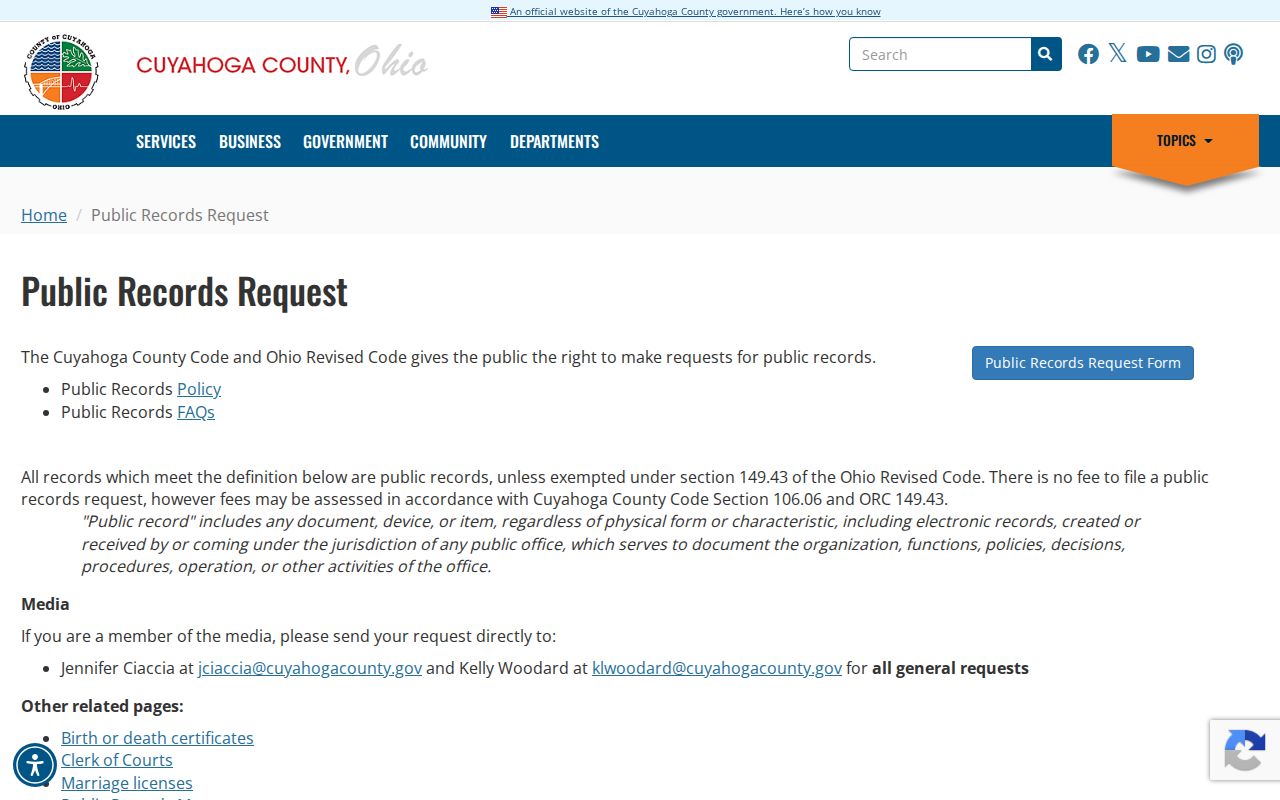
Turn to the request route when a past or released booking is not visible through a current roster. The response can also tell you which office actually controls the record.
Ohio Mugshot Law and Cuyahoga Records
Ohio Revised Code 149.43 sets the state's public-records framework, though exemptions and record-by-record review apply. Ohio's full-service jail rule explains why an intake record exists, but it does not force every internal field into a public app. Juvenile photographs carry separate limits under ORC 2151.313. The adult Sheriff app is no license to seek or publish them.
Removal is its own territory. ORC 2927.22 covers soliciting or accepting consideration from the subject of criminal-record information in exchange for removal, correction, modification, or nonpublication. It is not a blanket order forcing every lawful source to take down a booking photo. Start with the agency that created the record. That covers a wrong name, date, charge, or photo. For a case that might qualify for sealing or expungement, use the Cuyahoga Common Pleas expungement resources and current Ohio law.
Fixing a record takes three different doors. A court order is one thing. An agency correction is another. A publisher may also have its own voluntary takedown process, separate from both. Whichever track applies, keep copies. Send the order or correction straight to whoever holds the source. Never pay a removal fee, since none of these routes requires one.
Some mugshot publishers set their own removal terms. Read them directly. Busted Newspaper describes a free form that asks for the listing URL and legal proof. RecentlyBooked says it takes no payment for changes or removals. Mugshots.com takes none either and points to expungement. Mugshots.zone, MugshotsOnline, and the Arrests.org Ohio page have no verified county-specific free process. None of these pages shows current custody. None replaces a court order.
Start with the court order. Send it to the official record custodian. The Cuyahoga County Public Defender and the Common Pleas resources can help you navigate locally, though eligibility depends on the current statute, the facts, and the court process. When the source record changes, a stale search result may need its own refresh request. Even then, an independent cache or repost can linger.
Find Cuyahoga County Busted Mugshots
Begin with custody status, not a copied image. A name-only hit proves little. The official county route is the Sheriff's app, and a city police record can exist even when the person never entered county jail. After booking, the court docket matters most. State prison, federal, and immigration systems run separately, each with its own coverage and photo practices.
Gather three things first. A full name, an approximate date, and the arresting agency. That combination cuts the risk of matching the wrong person. If the record is old or the app returns nothing, take the public-records path instead of assuming a release, a transfer, or a missing file.
The Ohio Department of Rehabilitation and Correction answers a different question. Use it for someone in state prison, under DRC supervision, judicially released, or listed as a violator at large. Its public detail view can show an offender photo, admission information, institution, offense, sentence, and docket data. It is not the CCCC booking channel. The federal BOP locator and the ICE Online Detainee Locator likewise cover separate custody questions. Neither offers a county booking photo.
- Check the official Sheriff app for current or recent Cuyahoga County custody.
- Check the arresting department’s official route. Lakewood has a daily event bulletin; Cleveland and Parma use police records channels for a comprehensive record.
- Search the Cuyahoga County Common Pleas criminal docket for post-booking case activity, while recognizing that municipal matters can follow another court path.
- Use ODRC Offender Search only for Ohio prison, supervision, judicial-release, or violator-at-large records.
- Use the BOP locator or ICE locator only where federal or immigration custody is actually relevant. Neither is a county booking roster.
- Send a precise request to the Sheriff or arresting agency if the official channels leave a records question unresolved.
Cuyahoga County Custody and Mugshot Channels
Each source answers a different stage of a case. Official channels should come first. They name the office responsible for the record, which makes it far easier to tell a new jail entry from an old police report, a state-prison profile, or a later court event.
Aggregator pages can still be useful. One may preserve an older lead, an alternate spelling, or a booking date that official sources no longer surface. Their current-custody status, though, is anyone's guess. Busted Newspaper, RecentlyBooked, Mugshots.com, Arrests.org, Mugshots.zone, and MugshotsOnline are secondary resources, so treat each as unofficial and possibly incomplete or stale. Confirm what you find through the agency, the app, or the docket.
Local news is its own channel. Cleveland 19 and News 5 Cleveland carry rolling crime coverage, while the Cuyahoga County Prosecutor newsroom posts official case developments. Photos vary by story, and no outlet serves as a complete CCCC booking feed. A reported arrest still needs the right record check before it becomes a settled account.
| Channel | Custody or record scope | Photo status and access |
|---|---|---|
| Sheriff app | Current or recent county jail custody | Photo was reported at launch; the county’s web page directs readers to the app. |
| City police records | Arresting-agency report | Request the defined record from Cleveland, Parma, or Lakewood. |
| Common Pleas docket | Later criminal case history | No booking-photo promise; use for charges, hearings, and disposition. |
| ODRC profile | State prison or supervision | Public offender profile can include an offender photo, not necessarily the CCCC intake image. |
| County records request | County-held historical or released booking record | Subject to the custodian’s review, retention, and applicable restrictions. |
Cuyahoga Busted Roster in the Sheriff App
The CCCC inmate-information page offers no browser roster. There is no results screen. Instead, the county points the public to its official Sheriff app for daily jail rosters and push notifications. That app is the first official lead for current county custody. The web page itself supplies instructions and contacts rather than a public search form.
The county calls the roster daily. A launch report by The Marshall Project observed hourly updates and listed age, race, gender, photograph, jail-entry date and time, and charges. Both descriptions matter. Daily is the county's published wording, while hourly was only an observation at launch. Check the live app for what it currently shows. Do not treat either cadence as fixed.
| App information | What the located sources establish |
|---|---|
| Official access | County inmate information directs readers to the Sheriff app; it is available for iOS and Android. |
| Roster scope | County custody and recent intake, including CCCC or a Sheriff-used satellite location. |
| Reported fields | Launch reporting described identity details, photo, jail-entry time, and charges. |
| Not established | No official browser field list, web photo policy, or fixed photo-persistence period was located. |
The official CCCC inmate-information page appears below. It is useful for the county's app instructions and booking contacts.
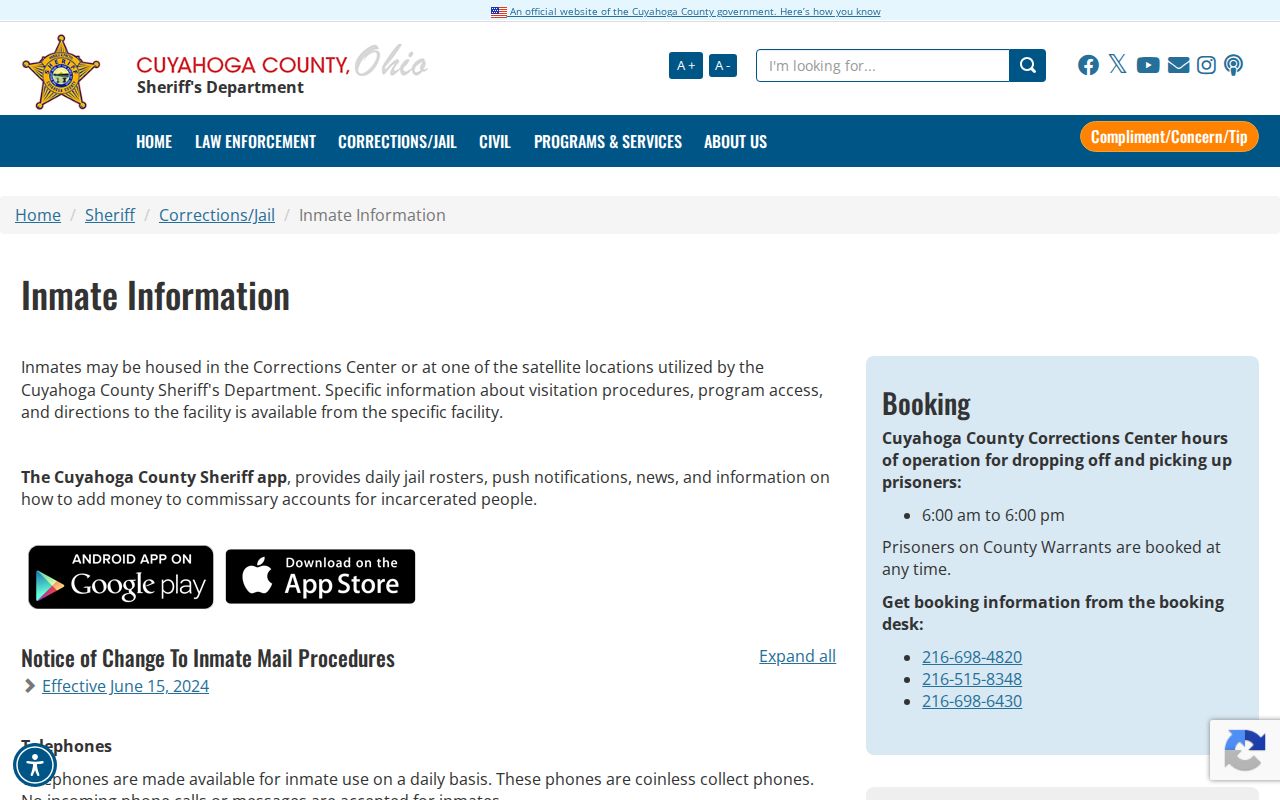
An empty app result proves very little. The person may have been transferred, booked before an update, or held at a satellite facility. An entry rule or a search mismatch can also hide a name. Absence from the roster is not absence from the system.
When the app cannot answer a current-custody question, call a county booking desk. The county lists three: 216-698-4820, 216-515-8348, and 216-698-6430. These are contact paths, not substitutes for the app or a court record. Confirm the right desk first. Then offer limited identifying details rather than a name-only match.
Cuyahoga County Booking Feed Windows
Cuyahoga County has no public browser page for a same-day, 48-hour, or weekly booking feed. Nothing official like that exists. The Sheriff app's current or daily roster is the nearest official channel. It promises no fixed interval, since a record may appear only after transport, booking, identity checks, and a roster refresh. Timing varies.
Lakewood has something the county lacks. Its official Police-2-Citizen Daily Bulletin is searchable by date and filterable to the AR arrest event type. That is a city event log, though, not a county jail feed. Cleveland and Parma have no comparable daily official photo feed. Someone logged in a city bulletin may not be in CCCC custody at all, and a CCCC entry does not tell you which city department made the arrest.
Private sites like RecentlyBooked, Mugshots.zone, and Busted Newspaper push rolling or dated entries. Treat them as secondary. Their posting windows can shift without notice. Note: County booking drop-off and pick-up hours run 6:00 a.m. to 6:00 p.m., and county-warrant prisoners may be booked at any time.
Cuyahoga Busted Cases After Booking
A booking entry is where the trail begins, not where it ends. To follow a case after the arrest, the Common Pleas criminal docket shows complaints, indictments, hearings, pleas, sentences, dismissals, and acquittals. Municipal court handles its own matters on a separate path. The Cuyahoga County Prosecutor newsroom sometimes reports case developments too, though it is no substitute for a booking roster.
- Booking
- Jail intake and identification after commitment.
- Arraignment
- A court appearance where charges are addressed and a plea may be entered.
- Bond
- A release condition set through the court process; it is not a finding of guilt.
- Disposition
- The court’s eventual recorded outcome, such as dismissal, acquittal, plea, or sentence.
Case outcomes live in the court record. A charge listed at booking can change; the docket is where the final result shows up.
Below is a screenshot of the criminal docket search. It is a post-booking case channel, not a sign that someone sits in jail today.
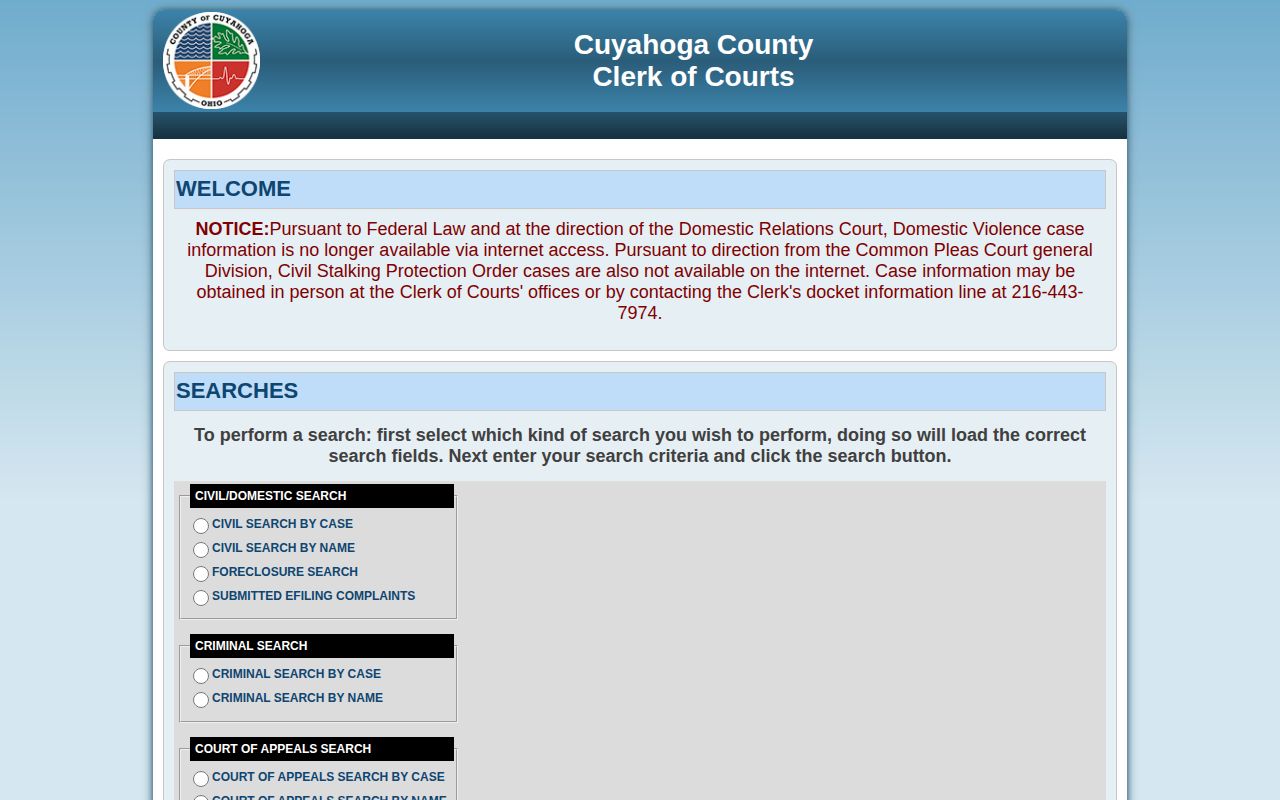
Read the docket dates and case number before drawing a connection to a similarly named booking entry.
The ODRC form covers state-level searches. You can query it by surname, first name, county of commitment, residential county, ZIP code, status, parole-board month, or an identifier. County of commitment means where the sentence came from, not necessarily a current address. Open the detail record before treating a result as a match, and keep its state-custody status separate from any older CCCC booking information.
Cuyahoga County Older Booking Records
Being searchable and being retained are two different things. The Sheriff Corrections schedule lists a five-year category for the Daily Jail Activity Log and a 30-day-or-capacity category for building surveillance video. No booking-photo-specific retention term appears in it. A five-year activity-log category, then, does not mean a particular mugshot stays available that long.
For an older county record, ask the Records/Warrant Division about its status. The item may still be held, transferred, destroyed under an approved schedule, restricted, or sitting with another office. The Cuyahoga County Archives handles historical records, but that is not proof modern CCCC photos were moved there. State prison history follows separate Ohio History Connection collections and access rules.
Write to an archive or records office with the exact name used at booking, a date range, the agency, and any identifier you know. The Archives can preserve historical material and manage temporary county records. It cannot recreate a modern image an agency lawfully destroyed. Old news photographs add context. They do not replace an official booking record or a court result.
Busted Mugshots by Cuyahoga City
Start with the arresting city. Cleveland's adult-arrestee policy sends adult arrestees to CCCC for processing and detention. Cleveland Police keeps the arrest records itself. Parma Police runs its own Record Room and posts no verified public daily arrest or mugshot blotter. Lakewood's official daily event bulletin helps pin down an incident date, but it guarantees neither county custody nor a photo.
- Cleveland Busted Mugshots explains the Cleveland Police records route and adult transport to CCCC.
- Parma Busted Mugshots covers the Parma Police Record Room, its written-request process, and the county-custody check when applicable.
- Lakewood Busted Mugshots distinguishes the Lakewood P2C arrest bulletin from a CCCC booking record.
Each city page leads with that police department's record channel. Turn to the Sheriff app only when the question is county custody or a transfer into CCCC.
Cuyahoga County Booking Timing and Alerts
Booking at the Cuyahoga County Corrections Center follows set windows. Drop-off and pick-up hours run from 6:00 a.m. to 6:00 p.m., while prisoners held on county warrants can be accepted at any hour. That difference alone explains why one person's name hits the arrest roster faster than another's. Timing says nothing about a photo, though. The county also notes that detainees may sit in CCCC or in Sheriff-used satellite locations, so confirm where a person is actually held.
Three separate services handle three separate jobs. The Sheriff app sends roster notifications. For custody-status and release alerts, the county points to VINE, a distinct service that does not provide booking photos. Crime Stoppers sits apart from both; it takes anonymous tips about wanted persons and may pay rewards, but it is not a jail-roster alert system. A new Garfield Heights facility is expected to open in 2029, so official custody routing could shift down the road.
Each tool has limits worth knowing. VINE can send a custody or release notice through whatever methods it offers, yet Ohio warns users not to lean on it alone for safety. Crime Stoppers wants information about a wanted person, never a reason to confront anyone. Follow the instructions each service displays. The app, VINE, and the tip line were built for different purposes.